可能的方向
实验(联合西湖大学)
-
Integrator dynamics in the cortico-basal ganglia loop for flexible motor timing
-
An approximate line attractor in the hypothalamus encodes an aggressive state
-
A circuit that integrates drive state and social contact to gate mating
-
A line attractor maintains aggressiveness during feeding in 'hangry' mice
-
Encoding of female mating dynamics by a hypothalamic line attractor
-
Causal evidence of a line attractor encoding an affective state
meta-learning(biologically plausible learning rule)
-
The neural computation of affective internal states in the hypothalamus - A dynamical systems perspective
-
A line attractor encoding a persistent state requires neuropeptide signaling
自下而上的方法: 通过病毒和基因编辑, 钙成像神经活动, 研究同一区域(腹内侧下丘脑 VMH)不同神经调节受体(催产素 OXT, 精氨酸加压素 AVP) 局部失活的影响.
社交行为(如攻击性)的神经元集群可构成一个近似线性吸引子.
- Integration as a self-organizing process
embeded continuous attractors with random rnn
random rnn(DMFT), random matrix theory
- Symmetries and continuous attractors in disordered neural circuits
John Hopfield (Symmetric)
Associative Memory
discrete fixed point
degenerate manifold
Examples
- occular motor control
- ring attractors(head direction cells)
- place cells
- intrinsic behavior(aggression, mating...)
-
Existing model/theory
- Fine tuned connectivity
- 1996 S.Seung PNAS
$$ \tau\frac{\mathrm{d}x}{\mathrm{d}t} = Ax + \xi_{\tau} $$
-
Biological noisyness
问题: 是否存在一套学习规则, 使得神经网络在接受到一些实验数据的时候, 可以在无监督下自组织出对应的连续吸引子网络, 从而将现实世界的某低维变量嵌入到高维的 RNN 相空间中?
- 实验数据是否存在低维流形
2020: Manifold GPLVMs for discovering non-Euclidean latent structure in neural data 流形高斯过程隐变量模型: 还原了 Head Direction 的环结构
2018: Learning a latent manifold of odor representations from neural responses in piriform cortex: 不是证明了气味分子在现实世界构成低维流形, 而是从小鼠 piriform cortex 的神经活动中能够反推一个能解释这些响应的潜在嗅觉表征空间
-
能否在无监督下自组织, 从而恢复流形的 latent variable
-
是否存在某种生物学上可行的学习规则, 使得 RNN 能够将流形映射到自己的相空间中
Oja rule: Discovering plasticity rules that organize and maintain neural circuits
- 是否有不同的流形可以拓展应用目前学习的 random RNN 的理论框架?
- 线性吸引子: 能否构造一个协方差矩阵, 使得生成的调谐曲线能满足 aggression 等表征?
- 蝙蝠: (目前尚未查到比较完整的数据集) Three-dimensional head-direction coding in the bat brain: 并未构成想象中的球面吸引子, 而更像是一个环面吸引子
meeting notes:
-
$(\cos{\theta}, \sin{\theta})\rightarrow \vec{x}\in\mathbb{R}^{N}\rightarrow \mathrm{bump}$ 设计 $\Delta J_{ij}$, 使得具有一定初始化规则创建的 J0 通过具有一定内在结构的外部输入更新权重, 从而收敛至 optimized J matrix, 并且其更新规则需要是 local 的(而非机器学习中的梯度下降算法这类依赖于全局状态的方法)
-
线性吸引子: 搞清楚积分变量的累积是否具有方向性, 以及和速度输入的关系, aggression 是否能够用类扩散行为来描述. 比如小鼠的和 aggression 相关存在类似线性吸引子的机制, 攻击性的累积具体是怎样的机制? 这个需要具体确认一下(因为头朝向是一个旋转对称的系统, 而线性吸引子并不具有这个特性: 往一个方向和另一个方向的漂移是代表同一个生理过程吗? 还是往一个方向积分是提高攻击性, 另一个方向是减少攻击性? ...)
-
place cell 是否可以应用于 random RNN 理论框架 (是不是对 $\Gamma$ 协方差函数的 M matrix 进行修改, 以及新的协方差函数应该如何设计从而适应 place cell 单 bump 以及多 bump 的结构, grid cell 是六角晶格分布的 bump 因此两者还是存在神经集群活动模式的区别)
-
论文阅读:
- S. Seung 1996 PNAS: How the brain keeps the eyes still
- David Trank
-
继续 Follow 有关 3D 蝙蝠 head direction 的相关工作, 对其进行了解
-
补充的论文阅读材料:
- Multiscale representation of very large environments in the hippocampus of flying bats
- Large environments reveal the statistical structure governing hippocampal representations
- Universal statistics of hippocampal place fields across species and dimensionalities
- A thalamus-brainstem attractor network drives history-biased decisions
思路:
-
通过 universal... 的 place cells 数据集, 使用 symmetries... 中的 random RNN 框架, 先尝试构造 target manifold 以及对应的 weight matrix
- Data for "Multiscale representation of very large environments in the hippocampus of flying bats": Eliav CA1 200m 一维隧道数据

- *rats navigating in an 18.6 m² environment: 无法打开? 大 2D 环境大鼠 CA1 数据
- *蝙蝠在 5.8×4.6×2.7m3 房间中自由飞行时的 3D place fields: 未公开
- *1D 其它啮齿类: 小鼠 40 m virtual track 和大鼠 48 m 1D maze: 未公开
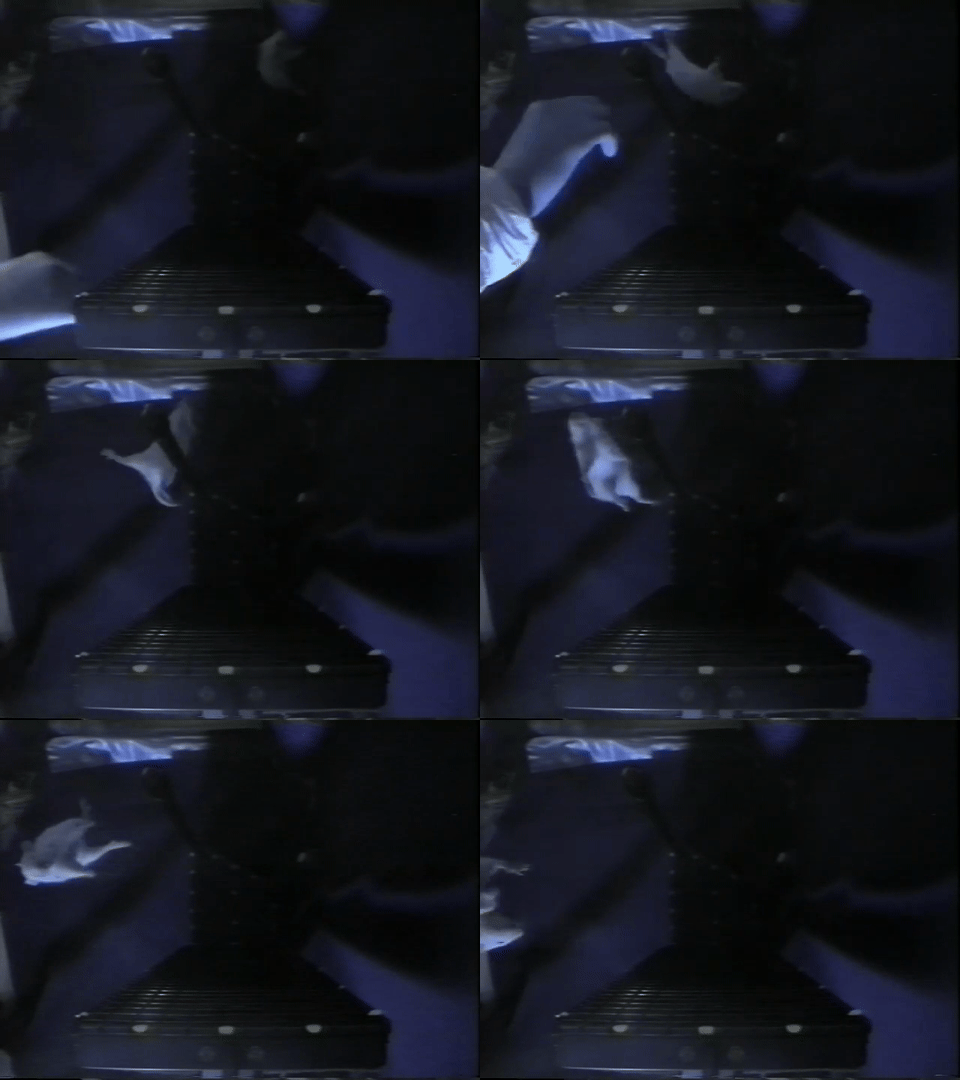
- Place Cells in Space: Hippocampal Recordings from the Space Shuttle: 1998 年小鼠漫游太空(dandi001754)
- CRCNS 各类数据集...
现实世界位置 $\vec{r}\in\Omega\subset\mathbb{R}^{D}$; 单神经元 $i$ 的 place field $\phi_{i}^{*}(\vec{r})$ (在 $\vec{r}$ 的平均放电率)
文章声称在高阈值条件下, field size, gap, Euler characteristic 等刻画 place field 的参数, 统计对于具体选取哪一个协方差函数并不敏感, 因此可以采用
$$ \Gamma(\vec{x}-\vec{x}^{\prime}) = A^{2}\exp{\left[-\frac{|\vec{x}-\vec{x}^{\prime}|^{2}}{2l^{2}}\right]} $$

异质性 place cell 的解码: $\hat{\vec{r}}(t) = \arg\max_{\vec{r}} \mathrm{Match}\left[\vec{\phi}(t), \vec{\phi}(\vec{r})\right]$
其中匹配算法有多种选择, 比如 Maximum likelihood 的 Poisson 核, overlap parameter (Clark 就是用的这个方法 $m(\theta,t) = \frac{1}{N}\sum_{i}\phi_{i}^{*}(\theta)\phi_{i}(t)$)等等.
-
通过 Gaussian process 构造的通性:
- Clark:
- 现实状态: 头朝向 $\theta\in [0,2\pi]$
- 随机变量: 输入电流场 $\vec{x}^{*}_{i}\sim \mathcal{N}(0,\mathbf{\Gamma}^{x}(\theta-\theta^{\prime}))$
- 非线性激活函数: $\phi(x) = 1 + \mathrm{erf}\left(\frac{\beta\sqrt{\pi}}{2}x\right)$
- Mainali:
- 现实状态: 位矢 $\vec{x}\in\mathbb{R}^{D}$,
- 随机变量: 输入电流场 $h(\vec{x})\sim \mathcal{GP}[\vec{0},\mathbf{r}(\vec{x}-\vec{x}^{\prime})]$
- 非线性激活函数: $f(\vec{x}) = \left[h(\vec{x}) - q\sqrt{\mathbf{r}(\vec{0})}\right]$
日期: 2026-06-13 标签: #line attractor随机变量 $\vec{x}\in\mathbb{R}^{d}$, 约束 $E[\vec{x}]=\vec{\mu}$ 和 $\mathrm{Cov}[\vec{x}] =\Sigma$.熵 $h[p(\vec{x})] = -\int p(\vec{x})\log{p(\vec{x})}\mathrm{d}\vec{x}$ 最大的是 $g(\vec{x}) = \frac{1}{(2\pi)^{\frac{d}{2}}|\Sigma|^{\frac{1}{2}}}\exp{\left[-\frac{1}{2}(\vec{x}-\vec{\mu})^T\Sigma^{-1}(\vec{x}-\vec{\mu})\right]}$.
- Clark:
-
*学习规则: 什么样的学习规则能使 weight matrix 学习到 Gaussian process?
-
确认小鼠线性吸引子的具体理论机制
-
agg 主要的驱动因素是社会交互(male intruder, sniffing, attack...)的相关输入, 而没有考虑类 random walk 的自发性升高机制
-
类比眼位 $E$ 的 $v_{i} = v_{i}^{0} + k_{i}E$, aggression 的 $a(t)\in\mathbb{R}$ 是一种一维连续变量, 引入 latent state $x_{1}$ 来描述 integration dimension, $x_{1}$ 越高, 攻击概率和攻击程度越高.
-
因此, 即使 $\lambda=0$ 描述刻画了线性吸引子 $\pm$ 增长的 neutral stability, 但是 aggression 仍应被理解为一个具有方向性的积分器: $x_{1}\uparrow$, agg $\uparrow$; $x_{1}\downarrow$, agg $\downarrow$.
-
aggression 不能简单地被理解为 integrate-and-fire 行为. 以 $a$ 表示 aggression 变量
$$ \begin{aligned} \dot{a}(t) &= -\frac{a(t)-a_{0}}{\tau} + v_{\mathrm{social}}(t) + v_{\mathrm{state}}(t) + \xi(t)\\ P(\mathrm{attack}) &= \sigma[\beta(a(t)-a_{\mathrm{thresh}})]\end{aligned} $$
即没有后续社交或饥饿等输入后, aggression 会以很慢的速度往 baseline $a_{0}$ 跌落. 若将其放置于一个短时系统中, 将会表现出 history dependence. 积分总是从当前状态 $a(t)$ 开始
并且, 在攻击产生之后, $a$ 值也不会立刻归零, 高 $a$ 可持续约 80s, 而单次 attack bout 仅持续 5s. 这也确保了小鼠从攻击到进食行为的切换: 在进食完毕后仍保留较高的 $a$.
-
Todo:
-
*阅读 A thamalus-brainstem attractor network drives history-biased decisions, 探索是否有将其和 random RNN 框架结合的可能性
-
Follow 有关 universal statistics of hippocampal place fields across species and dimensionalities 的工作中和学习规则有关的部分
-
做一个小型的 weight matrix learning 实验, 看下能不能通过 local learning rule 逼近 $J_{ij}$ 矩阵
Clark: 通过 $K^{-1}_{i,\lambda}$ 离线优化 $J$
切入口: 将伪逆解替换为 online learning rule
meeting notes:
课题:
-
目前 Clark 已实现 offline 的 optimized weight matrix 用于产生 ring attractor, 是否存在某种 local learning rule 能够逼近这类 optimized weight matrix?
$\dot{J}_{ij} = F[\vec{r}(t), J_{ij}]$
-
是否可以将 Clark 的方法推广至 place cells 相关数据集?
-
复现 Clark disordered ring attractor 的实验平台和动力学
-
系统测试 classical local learning rules 是否能从 sensory-clamped heterogeneous activity(感知输入引起的异质性神经活动) 自组织出 quasi-continuous attractor
-
使用 meta-learning 在 local rule basis 上搜索最小 plasticity motif, 并解释其与经典 Hebbian/Oja/BCM 等 plasticity 的关系
meeting notes:
课题的艰难探索
-
完成 Hebbian 等 learning rule 的 baseline 实现
- Classical continuous attractor
- Heterogeneous tuning curve
-
Literature research
- CA3 数据集寻找 (dandi...)
- attractor in hippocampus 相关论文
- 以及更多...
-
Proposal 确定
- 找到感兴趣的方向, 找到自己想要解决的问题 (只是把现有的 random RNN 推广到 place cell 数据集上, 这种缝合行为是一个真正的问题吗? )
神经回路如何在没有 global error signal 的情况下, self-organize 并且 maintain some low-dim dynamical motif
低维神经动力学如何在异质, 随机, 局部可塑的神经网络中形成并且维持? (How can low dimensional dynamical motifs self-organize and maintain in neural circuits without global error signal)
Clark's random RNN: 提供了一套分析逻辑, 用于判断是否出现了 continuous attractor
Idea notes:
让视觉线索作为外界 teacher, 自运动角速度输入作为需要学习积分的 idiothetic cue, 使得网络学会在无视觉输入时通过角速度做 path integration.
模型的 local learning rule 是在发育期完成的, 成熟期的网络已经形成 quasi-continuous attractor
HD cells: head direction cells, 排列为 ring. 群体活动为 bump, bump 位置对应动物对头朝向的估计
HR cells: head rotation cells, 同时接受 HD bump 和角速度输入, 分为 leftward 和 rightward 两个侧翼(wing), 分别负责将 bump 往左和右推动
Visual input: 视觉输入不是最终测试时必须存在的信号, 而是训练期的 teacher. 告诉 HD 现在 bump 应该在哪里, 作为 supervisory signal
meeting notes:
- 下载 learningPI 的 github 代码, 和自己的 toy model 实现进行核实
- 重新规范画图时间轴, 清楚单位时间的含义; 计算 drift 的角速度大小
- 搞清楚在学习过程中的 visual input 是怎样的形式, 是 fixed profile 吗?
- Hippocampus place cell 相关
- pathway : LEC & MEC -> DG -> CA3 (recurrent) -> (BTSP, 详情见 2024 年的论文) CA1
- grid cell -> high dimensional sparse representation -> CA3 place cell (place cell 实际上在 DG, CA3, CA1 都有, 而 CA3 中会和 HD 类似具有难以去除的 drift 效应)
- 更抽象层面的规律: low dim manifold 在 cortex 间的传递/继承(inheritance)?
继续阅读文献, 等待导师发整理后的 lists.
meeting notes:
-
visual input 的形式
- 更换为 + noise 形式
- tuning curve sampled by Gaussian generative process,
还能够学到 quasi-continuous attractor 结构吗?
-
visualize: 尝试 PC1&2&3 空间内的初态微扰跟踪, 评估 separation of time scales
-
延长 darkness 后 re-visual input 的时间, 观察 error 是否能重新跌落回到 0
-
尝试减少 neurons 数量(比如 16), 对比观察 metrices 的变化, evaluate the robustness of the local learning rule
-
尝试理论分析 spectrum of Jacobian, 尝试缝合 Clark 式的 attractor anlysis
-
完成 prospective dynamics 文章的阅读, 分析两者有何异同
-
重新精简一下 .ipynb 笔记中 path integration 相关的 experimental setup, 避免每次 meeting 的时候都要重新翻找 (特别是 OU process 的具体公式形式等等)
-
绘制权重矩阵跟随 training time 的变化
-
尝试解决有关 diffusion approximation of diffusion phenomena 的问题, 并且解出具体的 diffusion coefficient
-
重新梳理 figures 文件夹的结构, 避免所有图全部混在同一个文件夹
-
gain 曲线需要绘制 in darkness 下的情况
目前的基础画图中, 除了在 visual cue 下的 velocity gain, 还应该评估在 darkness 下的 gain 进行对比; 同样地, 这样的比较也应该体现在跨 noise / num of neurons 的 metrices 中
- 绘制一下添加了 noise 之后的 visual cue, 从而体现出 visual cue 的 heterogeneity
meeting notes:
- 更高时间分辨率的 weight matrix development;
- 考虑不同的视觉 cue profile, 以及考虑引入 heterogeneous visual cue generator 的可能性
- 重新实现 bump drift 的计算, 看一下如何实现 diffusion coefficient 的计算
- 完成 prospective dynamics 文章的阅读, 并且先简单实现 toy model 版本的复现
- 重新考虑 std 和 visual cue amplitude 的 scaling effect
- 考虑继续延长 noise std list, 一方面观察 gain 等 metrices 发生 bending down 的情况, 另一方面细扫 critical noise std 看看临界行为是怎么发生的, 能否对其进行更理论性的分析
有必要开发一个基于 llm 的自动化文献阅读和整理工具. 目前的复制-粘贴-copilot翻译的效率非常低, 如果可以的话可以借鉴一下 这个 的实现方式
07.27 meeting notes:
-
阅读 Near-critical slow dynamics enable flexible temporal computations and generalization, 以确保合作
-
阅读老师所发的 proposal & manuscript, 注意这两个都是由 Claude 生成的, 因此需要注意里面的公式推导是否存在问题
-
阅读 Back to Continuous Attractors 文章
proposal 里面有提到过一种新的学习方法? 需要去确认
08.03
为代码库添加一个功能: 保存训练状态, 从而使得在训练结束之后能够重新读取状态并且继续训练
meeting notes:
- 重新确认目前的 PVA 是针对什么 firing rate 完成的.目前的神经元因为 Vafidis' learning rule 被设计为 2-compartment, 因此动力学依赖严格来说是一个 2D 方程组 ($\dot{I}{HD,d} = f{1}(\cdot), \dot{I}{HD} = f{2}(\cdot)$), 在这种情况下如何定义 Ramesan 所使用的 $q = \frac{1}{2}||F(x)||^{2}$? 确认一下非线性函数对于 state space 的影响
- 重新确认 PVA 的谱(variance-rank 图), 确认一下取 N = 3 的截断是否合理. 目前前三成分总和约为 55%
- 确认目前动力学方程的 stiffness, 确认目前的 Euler 法是否合理
- Diffrax package;
-
scipy.integrate.solve_ivp的method='BDF'或者method='Radau'
- 寻找更好的确认 attractor basin 的方法, 目前的 trajectories 追踪做得太糙了. 理论上来说 unstable 和 stable fixed point 应该是成对存在的
- 重新确认速度场的计算方法是怎么完成的, 是不是自己描述的那样, 以及是否有更好的方法; 以及如何理解蓝线和橙色线的测定, 两者的差异是如何产生的
- 确认训练终止的合理时间. 目前呈现的趋势是训练越长, weight norm 越大并且没有呈现出收敛趋势. 按照权重更新的动力学, 应该是会完全静止才对
- 确认 $I_{HD}, I_{HD,d}$ 和 $W_{HD\to HD}$, $W_{HR\to HD}$ 的更新顺序, 是同步还是特定的异步
开始着手本地 AI 模型的部署, 看下工作的效果能不能助力科研.
测试完了, 这效果真的是拉完了, 可能也就玩玩生图或者 NPC bot 这类.
目前的一些诊断性代码可以尝试使用多核算法优化一下, 每次训练的时间长, 总不能诊断的时候还要继续等
结论:当前阶段不建议把 Diffrax、BDF 或 Radau 接入主训练流程。应继续保留 dt=0.5 ms 的 ordered Euler 作为论文复现基线;dt=1 ms 和 10 ms 在现有 Eq. (4) 下都不稳定。更值得优先验证的是:只对 proximal compartment 的线性快模态使用精确指数更新,然后尝试 dt=1 ms。
1. 当前系统确实存在局部 stiffness
proximal voltage 满足
$$ C\dot V_a=-(g_L+g_D)V_a+g_DV_d+I_{\rm vis}. $$
当前参数是 $C=1\rm\,ms,\ g_L+g_D=3$,所以最快时间常数为
$$ \tau_{\rm prox}=\frac{C}{g_L+g_D}=0.333\rm\,ms. $$
这比其他时间常数快很多:
- proximal:0.333 ms
- distal voltage:10 ms
- synaptic filter:65 ms
- plasticity filter:100 ms
- OU velocity:500 ms
对应参数可见 vafidis_toy.yaml。代表性训练后 fixed point 的完整离散 Jacobian 给出约
$$ \operatorname{Re}\lambda\in[-3000,-7.5]\ {\rm s^{-1}}, $$
时间尺度比约 400,属于明显但结构非常局部的 split stiffness。
不过这个 Jacobian 是 ordered discrete map 的 Euler-equivalent flow;其中 HR firing rate 是代数更新,会人为产生 $-1/dt$ 量级模态,并不等价于一个标准连续 ODE,代码也明确说明了这一点:autonomous.py。
2. dt 的稳定性和成本
proximal Euler 的齐次放大因子是
$$ m=1-\frac{dt}{\tau_{\rm prox}}=1-3000\,dt. $$
| dt | $m$ | 判断 | 80,000 s 成本 |
|---|---|---|---|
| 10 ms | −29 | 强烈不稳定 | 不应使用 |
| 1 ms | −2 | 不稳定 | 不应使用 |
| 0.5 ms | −0.5 | 稳定,但快模态交替振荡 | 1.6 亿步,约 6.5 h |
| 0.25 ms | 0.25 | 稳定且非振荡 | 约 2 倍成本 |
| 0.125 ms | 0.625 | 更接近连续解 | 约 4 倍成本 |
当前代码正确地拒绝前两种情况:vafidis_toy.py。论文也明确采用 dt=0.5 ms 和 forward Euler:vafidis2022_paper.txt。
我做的同初态、恒定速度、1 s 短训练收敛测试中,以 dt=0.03125 ms 为参考:
dt=0.5 ms:HD-rate 轨迹相对误差约 0.69%,解码角 RMSE 约 $9.4\times10^{-4}\rm\,rad=0.054^\circ$;dt=0.25 ms:相应误差约减半;- 误差表现符合一阶 Euler 收敛,而成本基本严格按 $1/dt$ 增长。
因此不是“dt 越小越好”,而是:
- 复现论文数值协议:用
0.5 ms; - 检查连续时间收敛:抽取短片段,用
0.25/0.125 ms; - 没有必要把完整 80,000 s 都缩到
0.125 ms。
随机 OU 训练还要注意:换 dt 后,即使 seed 相同,也不是同一条 Brownian path。正式比较应使用确定性 velocity replay,或构造 coupled Brownian increments,否则网络差异里混入了输入轨迹差异。
3. 为什么暂时不应直接换 BDF/Radau/Diffrax
当前 step_vafidis_toy 是固定读写顺序的离散 map,包括:
- ordered/sequential updates;
- algebraic HR firing rate;
- Euler–Maruyama OU input;
- 每步局部 plasticity;
- 可选 constraints;
- 固定步长的视觉和速度输入。
所以它不能直接交给 solve_ivp 当作 $\dot y=f(t,y)$。若换成 BDF/Radau,必须先重新定义一个真正的 continuous ODE/DAE/SDE 模型;这已经是模型语义变更,而不只是换 solver。
SciPy 官方也把 BDF/Radau定位为 stiff continuous ODE solver,并建议提供 Jacobian;否则需要有限差分 Jacobian和隐式 LU 求解。SciPy solve_ivp 当前训练若把两套 weights 和 plasticity traces 全部作为状态,维数接近 15,000,隐式求解不太可能自动比当前的矩阵乘法 + 显式更新便宜。
Diffrax 同时支持 ODE/SDE,也有适用于 stiffness 的 Kvaerno/IMEX 方法,但隐式方法通常需要 adaptive controller;adaptive SDE 还要求正确构造 Brownian path。Diffrax solver guidance、adaptive SDE requirements 这意味着需要把 NumPy、RNG、状态和整个训练循环改写成 JAX 语义。目前只是为了处理一个对角线性快模态,这个代价过大。
导师推荐的这些 solver 更适合作为:
- frozen-weight、确定性 continuous ODE 的 reference solver;
- 验证 stiffness 和 Euler 收敛;
- 检查某个结论是否是离散化伪影;
而不是当前主训练 runner 的直接替代品。
4. 更合适的优化路径
proximal 方程是线性的。保持当前 ordered data stream,可以用一步精确解:
$$ V_{a}^{n+1}=V_{\star}+ e^{-(g_L+g_D)dt/C}(V_a^n-V_{\star}), \quad V_{\star}=\frac{g_DV_d^{n+1}+I_{\rm vis}^{n+1}}{g_L+g_D}. $$
它没有 Euler 稳定性限制,也不需要 Newton、Jacobian 或新依赖。
只做这一替换的短探针结果是:
dt=0.5 ms:HD-rate 误差从约 0.69% 降到 0.45%;dt=1 ms:误差约 0.87%,计算量约减半;dt=2 ms:误差约 1.63%;dt=10 ms:误差已约 7.8%,仍然太粗。
因此建议最终采用三种明确语义:
release_euler_dt0p5ms:论文复现基线,不改。fine_euler_dt0p125ms:只跑短时间收敛参考。exact_linear_proximal_dt1ms:候选快速模式,必须经过完整 weight/gain/bump 多 seed 对照后才能成为正式配置。
另外,BDF/Radau也不会自动解决 weight norm 不停止的问题。论文自己说明 proximal equilibrium input 不为零,从而存在“lack of strict convergence”:vafidis2022_paper.txt。最新 80,000 s 运行最后 16,000 s 内,两套 weight norm 仍增长约 6.7% 和 7.2%,这更像学习动力学性质,而不是 Euler instability。训练终止应检查相对 dW/dt、error window 和 bump/PI 功能是否平台化,而不能要求 weight norm 完全静止。
文件未修改。数值探针均为只读运行;相关动力学测试为 20 passed。
在暑校期间学到了一个有意思的概念 "dynamic range", 目前的代码有需要调整这个范围的必要吗?
目前代码存在的问题:
-
目前的 PI error 仍然处于非常荒谬的状态, 无论是 constant velocity 还是 OU process, 得到的 error 都非常大. 这还是在 best weight 下诊断的结果. 这是否和 "HR->HD 的权重增长速度快于 HD->HD 的增长速度" 有关?
-
目前的 trajectories 实验中, 一方面目前的实验非常失败, 另一方面目前的可视化非常臃肿, 而且也存在逻辑问题. 我认为应该按照这样的逻辑重新绘制:
- 左边仍然沿用 trajectories 的绘制方式;
- 中间绘制 initial cue angle 和 cue 充分弛豫后 angle 的对比图(理想情况下, 两者应当完全相同);
- 右边绘制 endpoint map 和 initial cue angle 的对比图, 去除之前遗留的 cue on set/off 等复杂可视化逻辑. 然后在该基础上推算 stable/unstable fixed point.
需要注意推算的合理性, 因为理论上形成的慢环流形 stable 和 unstable 应当是成对出现的.
-
从数值计算的角度重新核验一遍目前代码的动力学实现是否存在问题, 特别是如果采取了
exact_linear的计算方法, 是否仍然有必要继续沿用目前的 0.00025 和 50000 train duration. 之前虽然使用 1ms 计算并不严谨, 但是至少没有出现现在非常严重的 heading 无法 follow 的情况, 因此我高度怀疑目前的代码在数值计算上是存在问题的, 如果无法解决这个问题我无法安心实验并且相信其导出的结论